


Our cousins are people who approach wine, food, and travel with the same joy they bring to everything. We were going to be in town for a week, and they told us to get ready for a treat by doing some research on Jacques Selosse. We started in the kitchen with some champagne friendly snacks: Maine oysters, tuna sashimi, and lobster gougères materialized along with 6 tulip glasses. I knew this was going to be special, because every evening with this family is extraordinary. What I didn't know yet was that this would be one of the most extraordinary bottles I've ever had the privilege of drinking.
The bottle was a Jacques Selosse Champagne Grand Cru Extra-brut, “Le Mesnil-sur-Oger Les Carelles,” from the producer’s celebrated Lieux-dits series. It is a blanc de blancs (100% Chardonnay) from one of the most revered Grand Cru villages in all of Champagne.
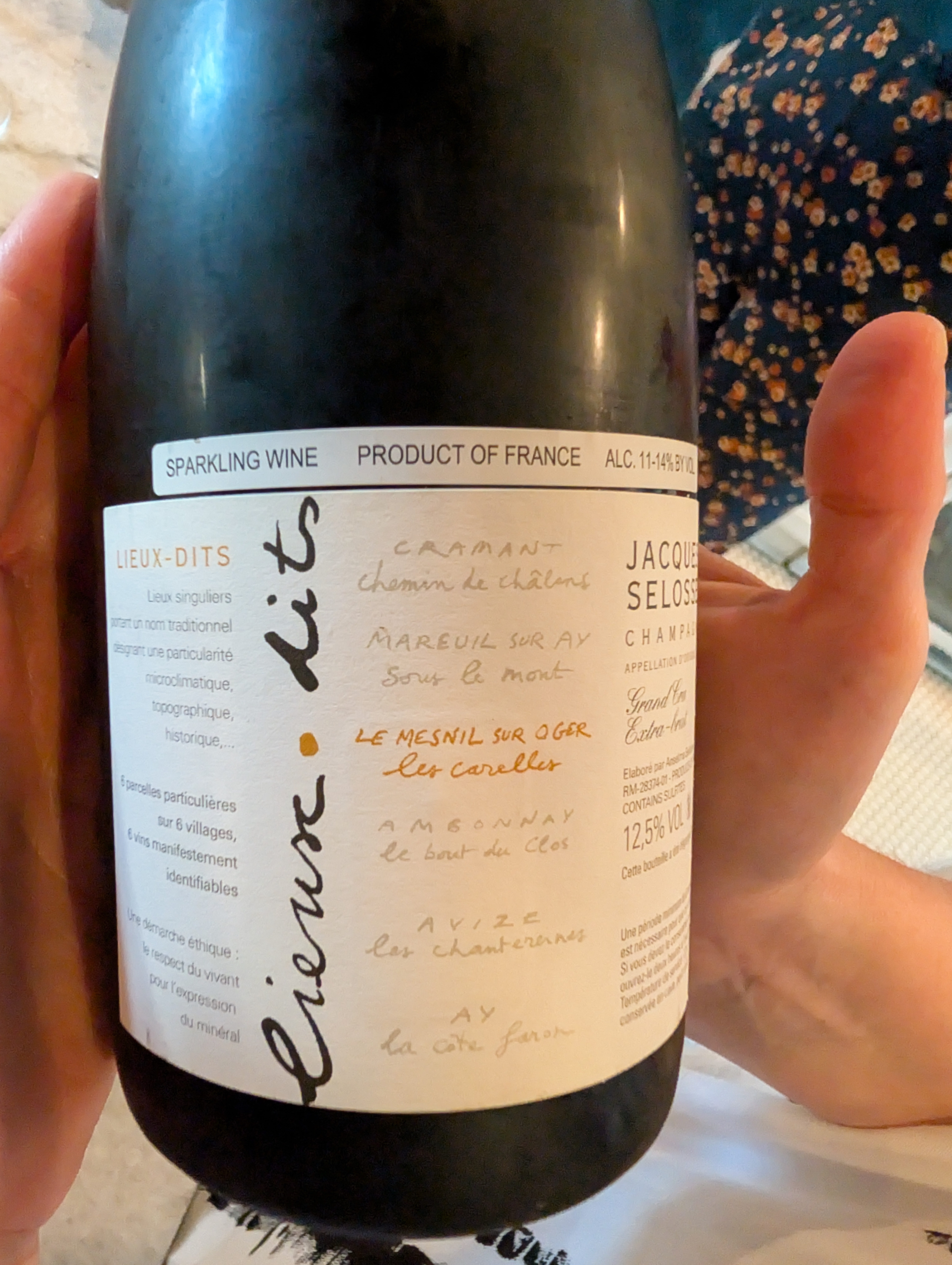
Who is Jacques Selosse?
Anselme Selosse is, depending on who you ask, either a genius or a provocateur. Probably both. He founded his eponymous house in Avize and proceeded to do something genuinely radical in Champagne: he made wine like a Burgundian. That means oxidative handling, barrel aging, extended lees contact, and deep attention to terroir at a time when most Champagne was being made to be consistent, not singular. He treated Chardonnay the way it gets treated in Chablis or Meursault, then put bubbles in it. These wines are not distributed outside France, so if you are lucky enough to be there (and have the funds), get on the hunt.
What is a Lieux-dits?
Lieux-dits is a French term for “named places.” They are singular parcels that carry a traditional name reflecting something distinctive about them: a microclimate, a topographic feature, a piece of local history. Selosse’s Lieux-dits series is a collection of single-vineyard expressions from some of Champagne’s most prized Grand Cru sites. Les Carelles sits in Le Mesnil-sur-Oger, a village so famous for its Chardonnay that the name alone commands reverence. The chalk is deep here.
Four wines in one sip
I typically find blanc de blancs to be linear. Beautiful, bright, precise, all acid and citrus. My heart belongs to white Burgundy, and when it comes to Champagne I usually reach for a blend or something Pinot Noir-dominant, because I want complexity and I want the red fruit that comes with it. I was not expecting this.
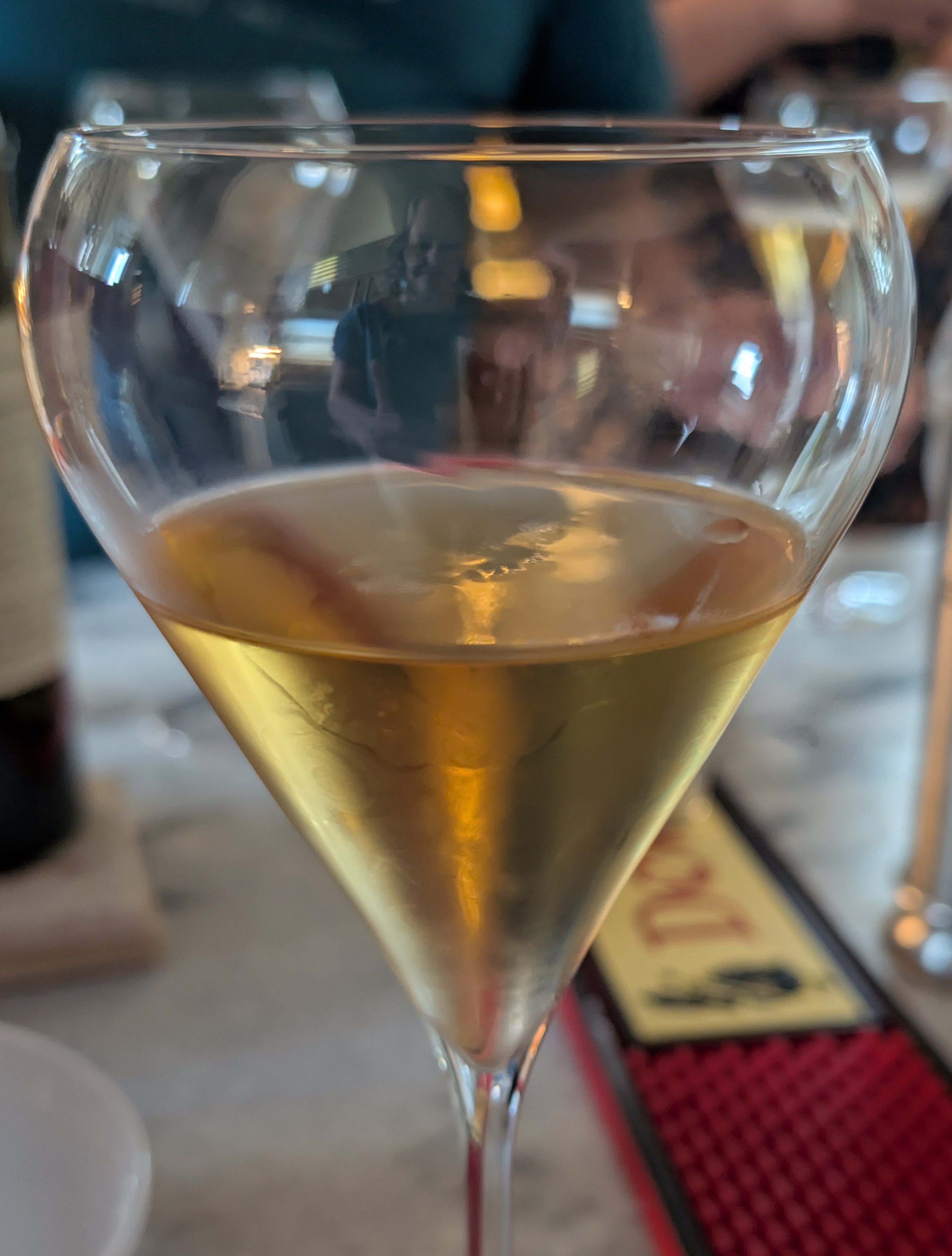
The color was the first signal: a rich, deep golden yellow, far from the pale straw of most blanc de blancs. The bubbles were impossibly small, more texture than effervescence. And from the very first sip, the wine kept changing.
Violet Beauregarde’s three-course-dinner chewing gum in Charlie and the Chocolate Factory moves through tomato soup, roast beef, and blueberry pie in a single piece of gum. This wine did something similar, minus the turning violet. One sip moved through four distinct experiences.
The front was Basque cider: nutty, oxidative, slightly funky, not like any Champagne I’d had before. Then the wine’s effervescence asserted itself: bright and acid-driven, all energy. Then something stranger and more beautiful: fuzzy peach candy, the kind from a corner store, with tart acid rising alongside it. And finally, on the finish, a long golden wave of white Burgundy: round, creamy, ripe yellow apple, chalk minerality arriving last and leaving a lasting impression.
The acid never disappeared. It moved, built up through the middle of each sip and then settled gently at the finish, like a wave that comes in fast and recedes slow. I have never experienced acid behaving quite like that before.
This is what Selosse’s oxidative style produces: layers. The nutty quality that comes from oxygen exposure is there, but it doesn’t dominate -- it creates depth. It gives the wine somewhere to go.
The Burgundy connection
A great Meursault (like the one that blew my mind, became my new obsession, and changed my understanding of excellent Chardonnay) is buttery without being heavy, round without losing its spine, long on the finish, and alive with yellow apple and mineral. Selosse took all of that and added bubbles and chalk and four hundred years of Champagne terroir.
Our cousins are the ones who first introduced me to the Meursault that changed my life. They described it as liquid gold, and they were right. This was the second time they handed me a glass and changed something. We were on our way to a beautiful French dinner that evening. But the stop I will always remember most is their kitchen.
Some bottles are inseparable from the people who open them. This is one of those bottles. Thanks, J&L ❤️