


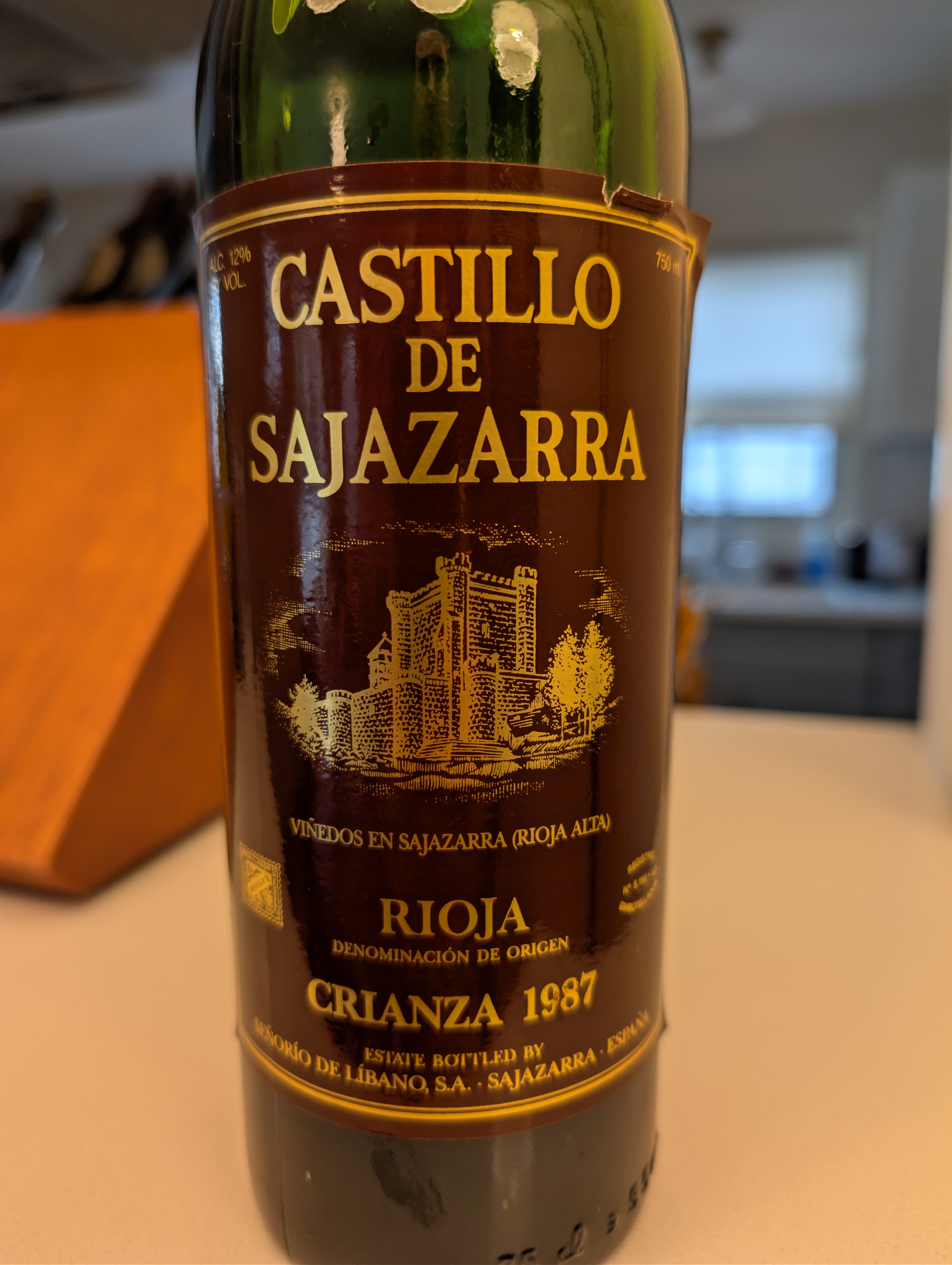
Starting with what’s in the glass, the Castillo de Sajazarra Rioja Crianza 1987 is cooked fruit, dried cherries, tobacco (soft and integrated), and an earthiness underneath it all. I was expecting it to be very barrel forward, but it was remarkably subtle! Our friends uncorked the bottle before bringing it over, and they found mould under the capsule — they didn’t have high hopes for it, but we were all astounded at what we found. If you’ve ever worried that old-world reds turn into vinegar science experiments, this one is a good argument against that fear.
So why does Rioja age so well in the first place?
Rioja, in northern Spain, is built for this. The region sits in a kind of geographic sweet spot — a confluence of Atlantic, Mediterranean, and continental influences — that gives its wines both structure and freshness. The main grape, Tempranillo, has the tannin backbone to survive long aging. But the real secret weapon is the oak.
Back in 1782, a winemaker named Don Manuel Quintano traveled to Bordeaux and came home with a revelation: aging wine in small oak barrels was what made French wines travel and age so well. His neighbors promptly created regulations to make the practice unprofitable. Decades later, a Peruvian named Luciano Murrieta tried again — same Bordeaux pilgrimage, same conclusion — but this time used cheaper American oak instead of French. The result was widely praised, and a tradition was born. (For more on Rioja history, check out this link to Wickham Wine)
American oak became the signature of classic Rioja largely by accident and economics. When phylloxera devastated Bordeaux in the late 1800s, French winemakers headed south to Rioja, bringing their expertise but unable to source French barrels. American oak was cheaper and more available. Because American oak is sawn rather than split, and kiln-dried rather than air-dried, it concentrates lactones that give wine those creamy vanilla notes Rioja became famous for. Vanilla, coconut, a little dill, leather.
The reason this 1987 Crianza isn’t overwhelmed by oak? Many traditional Rioja producers rarely buy new barrels, preferring to repair decades-old American oak already in their possession. Old barrels have already given their biggest flavors to previous wines. They become gentle. They oxygenate slowly. The wood steps back and lets the fruit do its thing — which, after 38 years, means cooked, complex, and still alive.
About that vintage.
1987 was not an easy year to be a grape in Rioja. After an extremely cold winter and a frost in May, the summer turned brutally hot, with August temperatures hitting 40°C and total rainfall for the whole growing season barely exceeding half the average. Then, right when harvest was about to start in September, it rained. Of course it did.
The growers who waited it out were rewarded — fully ripe, healthy grapes. The highest and latest-picked vineyards did best, which is why Rioja Alavesa came out ahead that year. Patience, as always, was the deciding factor.
A brief time capsule.
These grapes were ripening on the vine while Ronald Reagan was in his second term as president. A gallon of gas cost 90 cents. A gallon of milk ran about $1.07. A bottle of wine like this one would have set you back maybe $6–8 at a decent wine shop.
At the Grammys that February, Paul Simon won Album of the Year for Graceland. At the Oscars in March, Oliver Stone’s Platoon swept four awards including Best Picture. And on Broadway, Les Misérables was packing the house and took home the Grammy for Best Musical Theater Cast Album. It was a good year for things that took a long time to make and rewarded patience.
I was ten years old when those grapes were ripening. My family didn’t drink a lot of wine when I was growing up. For Christmas, my parents would splurge on a box of red and a box of white, expecting it to last through the New Year. It would take me 20 years to appreciate a glass of wine, and another 10 to fall in love with tempranillo. Nearly four decades later, the wine is still going. That’s not nothing.
Castillo de Sajazarra Rioja Crianza 1987. Cooked cherry, tobacco, quiet oak, and a whole lot of time.